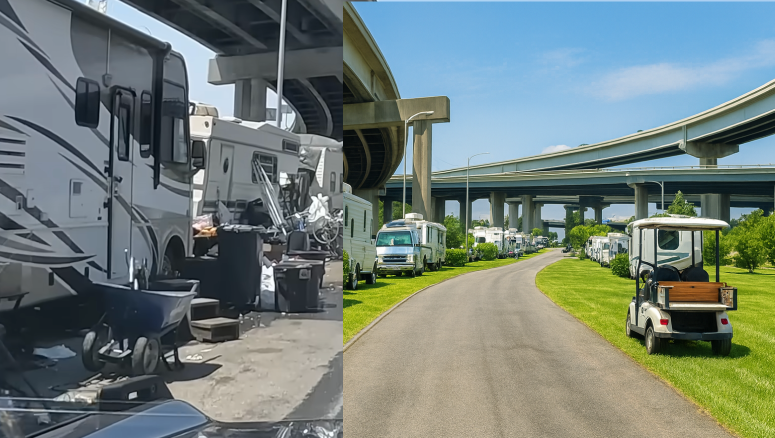
In a groundbreaking announcement that has Silicon Valley buzzing, ENVISEA AI has unveiled its revolutionary "Empathy-Free Commute™" technology—smart car windows that use AI to replace real-world poverty with beautiful golf courses in real-time.
The Problem Nobody Asked to Solve
"We noticed that wealthy tech workers were experiencing mild discomfort during their commutes," explains CEO Chad Monterey III, speaking from his Palo Alto office that overlooks a parking lot he wishes was a golf course. "They'd see things like homeless encampments, struggling families, or—and this is the worst part—people asking for help. We knew we had to disrupt this."
How It Works
The technology is surprisingly simple, which is why it required $47 million in Series A funding:
- Computer vision AI identifies "uncomfortable urban realities"
- Generative AI creates pristine golf courses, marina views, or luxury resorts
- Augmented reality windows overlay the fantasy onto your actual view
- Blockchain (they're not sure why, but investors loved it)
"It's like Instagram filters, but for empathy avoidance," says Monterey proudly.
The Features
ENVISEA AI isn't just replacing homeless camps with golf courses. The system includes several "vision enhancement modes":
- Country Club Mode: Replace poverty with golf courses (default setting)
- Yacht Club Mode: Transform urban blight into pristine marinas
- Tech Campus Mode: See everyone as a potential engineer or product manager
- Billionaire Mode: Everything becomes a luxury property you could buy
- Conscious Mode: Actually see reality (currently in beta, rarely used)
The Testimonials Are In
"Before ENVISEA, I'd sometimes feel bad during my commute from Atherton to Mountain View," says early adopter Jennifer K., a VP at a crypto startup. "Now I just see beautiful golf courses. My therapist says my guilt-induced stress is down 87%."
"I used to donate to homeless shelters," admits another user, who wished to remain anonymous. "But now that I don't see the problem, I can afford another investment property. It's a win-win!"
The Technology Behind the "Magic"
ENVISEA's proprietary AI, trained on thousands of images from luxury real estate listings and country club brochures, can identify and replace "uncomfortable visuals" in milliseconds:
- Tent city? Now it's the 18th hole at Pebble Beach
- Food bank line? Transformed into a champagne brunch queue
- Affordable housing complex? Now it's a gated community (which it will be soon anyway)
The Investment Community Is Thrilled
"This is exactly the kind of innovation Silicon Valley needs," says venture capitalist Blake Wealthington IV. "Instead of solving homelessness—which sounds hard and unprofitable—we're solving the discomfort of looking at homelessness. That's scalable."
The company has already raised $47 million in Series A, with a Series B round planned for next quarter to fund expansion into "yacht window technology" and "penthouse view enhancement systems."
The Roadmap
ENVISEA AI has ambitious plans for the future:
- Q1 2025: Launch in San Francisco (where it's needed most)
- Q2 2025: Expand to Los Angeles, Seattle, and other cities with visible inequality
- Q3 2025: AR glasses version for walking (never make eye contact with poverty again!)
- Q4 2025: Home window installations (why look at your neighborhood when you could see Monaco?)
- 2026: Full reality replacement suite (beta)
The Critics Are Confused
Some housing advocates have raised concerns about the technology.
"This is literally the most dystopian thing I've ever seen," says Maria Rodriguez, director of a housing nonprofit. "Instead of addressing poverty, we're just... making it invisible to rich people?"
CEO Monterey dismisses these concerns: "The critics just don't understand disruption. We're not making poverty invisible—we're making commutes more pleasant. Totally different."
The Partnership Opportunities
ENVISEA is already in talks with major automakers:
- Tesla: Considering it as a premium package ($12,000 add-on)
- Mercedes: Planning integration with S-Class models
- Rivian: Marketing it as "Conscious Comfort Technology"
The Fine Print
The system does come with some limitations:
- Doesn't actually solve any real problems
- May cause users to lose touch with reality entirely
- Could result in driving past your actual destination while admiring a digital golf course
- Requires active subscription ($49/month after trial period)
- Reality withdrawal symptoms reported in clinical trials
The Social Impact
When asked about the social implications of making poverty invisible to the wealthy, Monterey became thoughtful.
"Look, we're not saying homelessness isn't a problem. We're just saying it shouldn't be *my* problem during *my* commute. That's innovation."
The Competition
ENVISEA isn't alone in this space. Competitors are emerging:
- BlindSpot Technologies: Focuses on removing "inconvenient realities" from all viewing angles
- Serenity Vision: Replaces everything with beach scenes and puppies
- Reality+: Lets you customize what social problems you want to see (currently none are popular)
The Future Is Here (If You Can Afford It)
ENVISEA AI represents the pinnacle of Silicon Valley innovation: identifying a problem (wealthy discomfort), creating a solution that helps nobody except wealthy people, and raising millions in venture capital to scale it.
"This is what technology is all about," says Monterey, gazing out his window at a parking lot that his prototype makes look like Augusta National. "Making life better for people who can afford to make life better for themselves."
The Launch Event
ENVISEA AI plans a lavish launch event at a golf course in Pebble Beach. Ironically, attendees won't need the technology—the venue is already perfect.
Early bird pricing starts at just $8,999 for the basic system, with premium packages reaching $24,999. Installation not included. Monthly subscription required. Conscience sold separately.
ENVISEA AI: Because if you can't see the problem, is it really a problem? (Yes. Yes it is.)
Disclaimer: This is satire. Please don't actually build this. Please actually help people instead.